Education Is Not a Product: The Hidden Reality of Overseas Education Startups
The overseas education industry is witnessing the rise of heavily funded startups focused on sales rather than student success. This article explores why ethical counseling, financial awareness, and responsible guidance matter more than admissions targets.
 Haneeva Overseas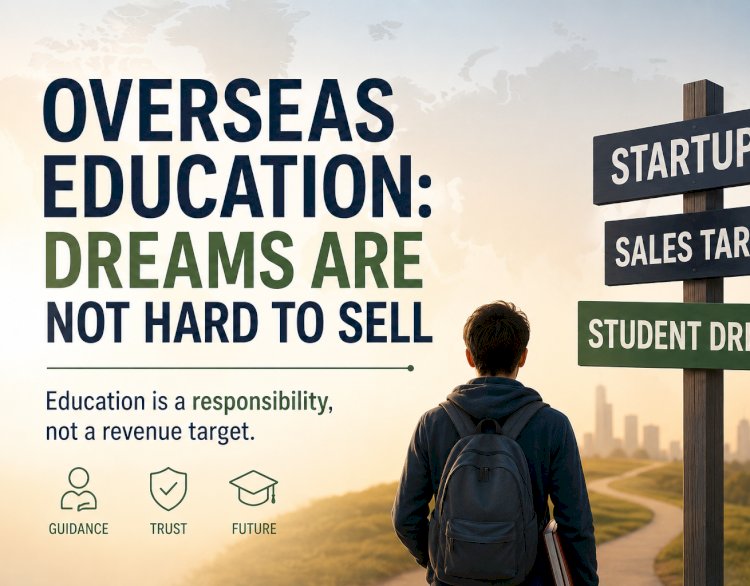
STARTUPS IN OVERSEAS EDUCATION: WHEN DREAMS
BECOME SALES TARGETS
The overseas education industry in India has transformed dramatically over the last decade. What was once an industry driven by experienced counselors and education experts is increasingly becoming a highly commercialized sector dominated by heavily funded startups.
Large investments, aggressive marketing campaigns, celebrity endorsements, expensive offices, and ambitious sales targets have changed the way overseas education is sold. Unfortunately, somewhere in this race for growth, the student is often becoming secondary.
Education is no longer treated as a dream to be nurtured but as a product to be sold.
The Byju's Lesson
The downfall of several EdTech companies has taught us an important lesson.
Many organizations received massive investments, hired large sales teams, offered attractive salaries, and set aggressive revenue targets. In several cases, products were sold to families who could barely afford them. Education loans were encouraged, and fear-based selling became common.
The result was financial stress for families, disappointment for students, and a loss of trust in the education sector.
Today, a similar trend can be observed in certain segments of the overseas education industry.
When Counselors Become Salespeople
A counselor's responsibility is to guide.
A salesperson's responsibility is to sell.
Unfortunately, many students today meet sales representatives who carry the title of "counselor." Their success is measured not by student outcomes but by monthly admission targets.
If a particular country offers higher commissions, it becomes the "best country."
If a university offers attractive incentives, it suddenly becomes the "top university."
Students often hear statements such as:
- "The UK is the best option."
- "Everyone is going to this country."
- "You must apply immediately."
- "This intake will change your life."
However, very few conversations happen about:
- Employment opportunities.
- Return on investment.
- Family financial conditions.
- Education loan burdens.
- Living expenses.
- Market realities.
Studying Abroad Is Not One-Size-Fits-All
Every student has a different background.
Some come from financially strong families.
Some are first-generation graduates.
Some parents mortgage their homes.
Some families sell land, break fixed deposits, or take large education loans to support their children's dreams.
Sending every student to the same country simply because it is easier to sell is not responsible counseling.
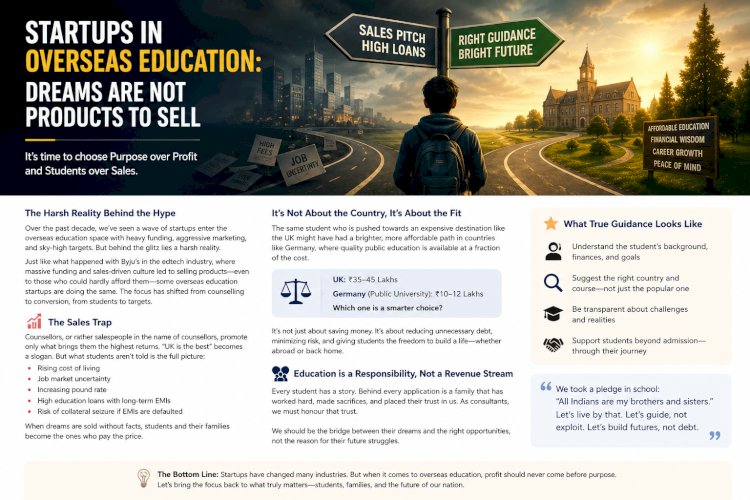
For example, a student considering a ₹40 lakh investment in an expensive destination may have an equally good opportunity in a country where education costs significantly less.
Germany's public universities, for instance, offer quality education at a fraction of the cost. In many cases, the total expense may be substantially lower than studying in expensive destinations.
For some students, this could be a financially safer option.
The right destination is not the most popular one.
The right destination is the one that matches the student's profile, goals, finances, and future plans.
The Reality of Education Loans
Education loans are valuable tools when used wisely.
However, taking large loans without understanding future repayment responsibilities can place enormous pressure on families.
Students who graduate and struggle to find employment may face:
- High monthly EMIs.
- Financial stress.
- Delayed career growth.
- Family pressure.
- Difficulty supporting parents.
- Emotional challenges.
When repayments become difficult, the burden often falls on the entire family.
This is why financial counseling is just as important as academic counseling.
Before recommending a destination, consultants should ask:
- Can this family comfortably afford this investment?
- What is the backup plan?
- What happens if the student returns to India?
- Is the loan amount manageable?
- Is there a more affordable alternative?
These questions protect students.
Education Is a Responsibility
Every application represents a family's trust.
Behind every student is a father working overtime, a mother making sacrifices, or parents investing their life's savings for their child's future.
As education consultants, our responsibility extends beyond admission letters and visa approvals.
We must:
- Understand the student's financial situation.
- Discuss both opportunities and challenges.
- Recommend countries responsibly.
- Present realistic expectations.
- Support students throughout their journey.
Education is not simply about sending students abroad.
It is about helping them build successful and sustainable futures.
Purpose Over Profit
The overseas education industry needs growth, innovation, and technology. Startups can contribute positively by improving access, simplifying applications, and increasing awareness.
However, profit should never come before purpose.
Success should not be measured by the number of admissions.
Success should be measured by:
- Students who build successful careers.
- Families who feel proud of their decisions.
- Graduates who repay their loans comfortably.
- Parents who sleep peacefully.
- Students who return and thank their counselors years later.
At the end of the day, education is not a sales target.
It is a dream.
And dreams deserve guidance, honesty, and responsibility.
Conclusion
As Indians, many of us grew up reciting a simple pledge:
"All Indians are my brothers and sisters."
If we truly believe this, then every student who walks into our office should be treated like family.
No student should be sent abroad simply because it benefits the consultant.
Students should be guided toward destinations where they can learn, grow, prosper, and build meaningful lives.
Because when a student succeeds, a family succeeds.
And when families succeed, the nation succeeds.