Study Bachelor’s in Italy After 12th: Complete Guide for Indian Students
Planning to study a Bachelor’s in Italy after 12th? Explore eligibility, CEnT-S, TOLC, SAT, IELTS, language requirements and the complete Italy undergraduate admission process for Indian students in 2026/27
 Haneeva Overseas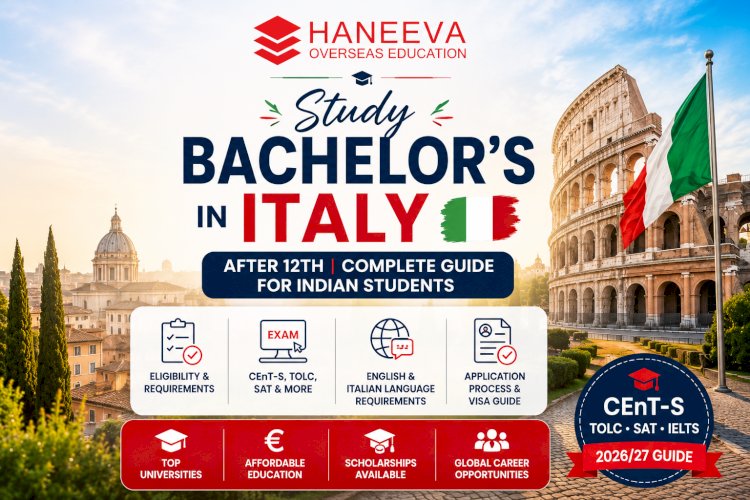
Study Bachelor’s in Italy After 12th: Complete Guide for Indian Students
Italy is increasingly becoming an attractive study destination for Indian students looking for an affordable European undergraduate education. With prestigious public universities, English-taught Bachelor’s programmes, scholarships and comparatively affordable tuition fees, Italy can be an excellent option after Class 12.
However, the Italian undergraduate admission system is different from countries such as the UK, USA or Australia. Depending on the university and programme, students may encounter entrance examinations such as CEnT-S, TOLC or SAT, along with language and academic requirements.
Importantly, there is no single entrance examination required for every Bachelor’s programme in Italy. The requirements depend on the university, programme, language of instruction and whether the programme has restricted admission.
Here is what Indian students planning for the 2026/27 intake need to understand.
Basic Eligibility: Can Indian Students Study in Italy After 12th?
Yes.
Indian students can apply for a Bachelor’s degree in Italy after completing Class 12.
As a general rule, a qualification used for admission to an Italian first-cycle/Bachelor’s programme must normally represent at least 12 years of schooling and must be suitable for access to higher education. Italian universities themselves are responsible for evaluating foreign qualifications.
Therefore, students completing the standard Indian 10+2 education system will generally meet the basic schooling-duration requirement, subject to the university evaluating the qualification and the specific programme requirements.
Students should also remember that universities may consider:
- Class 10 and Class 12 academic records
- Subjects studied in Class 12
- Mathematics/science prerequisites for technical programmes
- Entrance examination results
- English or Italian language ability
- Programme-specific admission requirements
Meeting the basic 12-year schooling requirement does not automatically guarantee admission.
What Is TOLC?
TOLC – Test Online CISIA is an admission and assessment system developed by CISIA and widely used by Italian universities.
Different versions of TOLC exist for different academic areas. For example:
- TOLC-I – commonly associated with Engineering and technical programmes
- TOLC-E – commonly associated with Economics and related programmes
- TOLC-F – Pharmacy and related areas
- TOLC-B / TOLC-S – science-related programmes
- TOLC-SU – humanities-related programmes
- Other specialised TOLC examinations are also available.
However, students applying to English-taught programmes need to pay particular attention to an important recent change.
Major Change: English TOLC Has Been Replaced by CEnT-S
Until recently, international students frequently encountered exams such as English TOLC-I, English TOLC-E and English TOLC-F.
CISIA has now introduced a new examination called:
CEnT-S – CISIA English Test – Sciences
Starting from November 2025, CEnT-S replaced the previous English TOLC-I, English TOLC-E and English TOLC-F for participating English-taught degree programmes.
CEnT-S may be used for admission to English-taught programmes in areas including:
Engineering | Economics | Sciences | Biology | Pharmacy | Psychology | Agriculture
The CEnT-S consists of 55 questions and has a maximum duration of 110 minutes.
The examination covers:
| Section | Questions | Time |
|---|---|---|
| Mathematics | 15 | 30 minutes |
| Reasoning on Texts & Data | 15 | 30 minutes |
| Biology | 10 | 20 minutes |
| Chemistry | 10 | 20 minutes |
| Physics | 5 | 10 minutes |
| Total | 55 | 110 minutes |
CEnT-S can be offered either remotely through CEnT@HOME or at participating universities through CEnT@UNI, depending on the university's admission rules.
Students should not assume that every English-taught Bachelor’s programme requires CEnT-S. Always check the official admission call for the specific programme.
Is SAT Required to Study a Bachelor’s in Italy?
No. SAT is not a general national requirement for studying in Italy.
However, some Italian universities and individual international Bachelor’s programmes accept or require the SAT as part of their selection process.
For example, the University of Bologna confirms that some of its international programmes use SAT for admission. Certain programmes may use SAT instead of, or alongside, CISIA-based admission tests.
Therefore:
SAT required for every Italian university? → No
Can SAT be required or accepted by individual universities? → Yes
This is why students should first shortlist their programme and then check its specific admission notice before registering for an entrance exam.
Is IELTS Mandatory for Italy?
Another common misconception is that every Indian student must take IELTS before applying to Italy.
IELTS is not universally mandatory across all Italian universities.
For an English-taught Bachelor’s programme, the university will specify how the applicant must demonstrate the required English proficiency.
Depending on the programme, acceptable evidence may include recognised English-language certifications, university-specific language assessments or other forms of evidence accepted by that institution.
Many programmes expect approximately B2-level English, but the exact requirement and accepted certificates vary.
Some programmes specifically accept examinations such as IELTS or TOEFL, while others may provide different ways of satisfying the language requirement.
Therefore, students should never assume that either:
“IELTS is compulsory everywhere in Italy”
or
“Italy does not require IELTS.”
Both statements are too broad. The correct answer is that English-language requirements are programme-specific.
Do I Need to Know Italian?
That depends primarily on the language in which your degree is taught.
For an English-Taught Bachelor’s
Students are generally not required to demonstrate Italian proficiency simply because they are studying in Italy. Instead, they must satisfy the English-language requirements specified by the university.
Learning basic Italian is nevertheless strongly recommended for everyday life, internships, networking and future employment.
For an Italian-Taught Bachelor’s
Students will normally need to demonstrate adequate Italian-language proficiency according to the university's requirements. Italian universities test the linguistic competence of international students applying for programmes taught in Italian, with exemptions possible for students holding recognised qualifications or certifications.
A B2 level of Italian is an important benchmark commonly encountered in the Italian system.
Which Entrance Exam Will I Need?
There is no single answer.
A student applying to Italy may encounter:
CEnT-S
For participating English-taught programmes, particularly in scientific, engineering, economics and related fields.
TOLC
Still widely used, particularly for Italian-language programmes and other programme-specific admission procedures.
SAT
Accepted or required by certain international Bachelor’s programmes.
University-Specific Entrance Test or Interview
Some universities conduct their own assessment.
No Competitive Entrance Examination
Certain open-access programmes may instead assess academic eligibility and impose other initial-knowledge requirements.
The golden rule is simple:
First choose the university and programme. Then identify the examination required by that programme.
Do not take SAT, TOLC or CEnT-S simply because another student applying to Italy is taking it.
How Does the Application Process Work for Indian Students?
For a typical Indian student applying for a Bachelor’s degree in Italy, the process broadly looks like this:
Step 1 – Shortlist the programme
Identify whether the Bachelor’s is taught in English or Italian and check academic prerequisites.
Step 2 – Check the official admission call
Determine whether the programme requires CEnT-S, TOLC, SAT, another entrance examination or no competitive test.
Step 3 – Meet the language requirement
Provide the English or Italian language evidence required by the programme.
Step 4 – Apply directly to the university
Follow the university's application procedure and deadlines.
Step 5 – Complete Universitaly pre-enrolment
For Indian students requiring a study visa, pre-enrolment through the official Universitaly portal is a mandatory part of the process.
Step 6 – Qualification verification/documentation
Depending on the university and individual case, documents relating to recognition/verification of the Indian qualification may be requested, including procedures involving documents such as a Declaration of Value or other recognised verification documentation.
Step 7 – Apply for the Italian Study Visa
For a normal Bachelor’s degree lasting more than 90 days, an Indian student will generally require a National Type-D Study Visa.
For the 2026/27 academic year, the national procedures state that study-visa applications for degree programmes must be submitted no later than 30 November 2026, although universities can establish significantly earlier programme and enrolment deadlines.
Indian students should therefore never wait until the national visa deadline to begin their process.
Quick Summary for Indian Students
| Requirement | Is It Mandatory? |
| Class 12 / 12 years of schooling | Generally Yes |
| CEnT-S | Depends on programme |
| TOLC | Depends on programme |
| SAT | Not universally required |
| IELTS | Not universally required |
| English proficiency for English-taught courses | Yes, as specified by university |
| Italian for English-taught programmes | Generally not an admission requirement |
| Italian proficiency for Italian-taught programmes | Normally required |
| Universitaly pre-enrolment for visa applicants | Yes |
| Student visa for Indian students | Yes, for long-term degree study |
Final Thoughts
Italy can be an excellent undergraduate destination for Indian students, but its admission system requires careful planning.
The biggest mistake students can make is assuming that one entrance examination applies to every university.
With the introduction of CEnT-S and the replacement of the previous English TOLC examinations, understanding the latest admission requirements has become even more important.
Before applying, students should check four things carefully:
Which programme do I want? → Which entrance test does it require? → Which language requirement applies? → What are the university and Universitaly deadlines?
Once these four questions are answered correctly, the Italian undergraduate application process becomes considerably easier to navigate.
Admission requirements, entrance tests, accepted language certificates and deadlines can change by university and academic year. Students should always verify the latest official admission notice for their chosen programme before applying.
Haneva Overseas Education
Helping students make informed choices for their international education journey.